
Approach
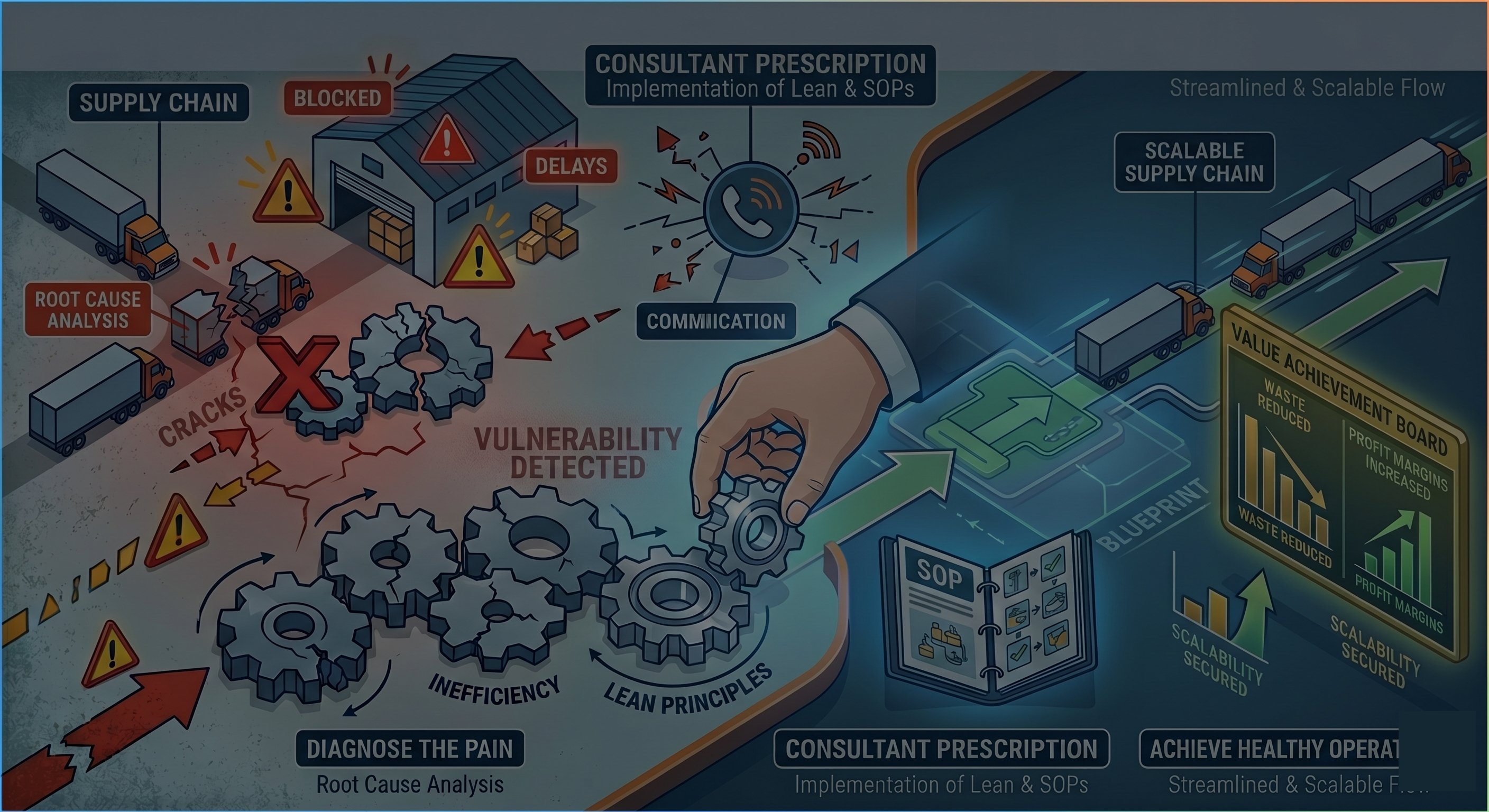
Engineering applied to operations is the easy part to describe. Doing it well — in real organizations, with real people, against real deadlines — is the practice.
Operating principles
We do not arrive with a binder of frameworks waiting for a use case. Every engagement starts with the operation as it actually runs — measured, mapped, understood — before any methodology gets named.
Lean, Six Sigma, Theory of Constraints, simulation modeling — these are tools. The right one depends on what is actually constraining the operation. The wrong one is whichever fits worst.
Throughput, cycle time, capacity, OEE, line balance, WIP, queue length. The numbers do not lie about an operation. We make sure the numbers are correct, and that everyone in the room is reading them the same way.
A finished assessment is not a finished engagement. The operation has to actually change. That means standard work, training, instrumentation, and the unglamorous follow-through that makes the gain stick.
The arc of an engagement
A representative timeline for a focused operations engagement. Larger redesigns and embedded multi-year partnerships scale the same skeleton.
Phase / 01
Weeks 0–2
Time on the floor. Conversations with operators, supervisors, and owners. A clear-eyed picture of how the operation runs today — including the workarounds, the tribal knowledge, and the things nobody wrote down.
Phase / 02
Weeks 1–4
The diagnostic phase. Time studies, downtime logs, rework counts, cycle-time distributions, throughput against capacity. Building the dataset that will let us point at the real bottleneck rather than the loudest complaint.
Phase / 03
Weeks 3–8
Future-state design. Process redesign, layout changes, staffing models, scheduling rules, KPIs. Validated where useful with discrete event simulation. Reviewed with the people who will actually have to live inside the new design.
Phase / 04
Weeks 6–16+
Pilots first, then phased rollout. Standard work documented and trained in. Dashboards stood up so leadership can see whether the change held. The consultant leaves; the gain stays.
Where do we start?